From outside Japan you meet the same three names first: UNIQLO, ZOZOTOWN, and a white sneaker with two stripes. Then the map goes blank. Past the blank there is an online shop that opened with seventeen stores inside it, a sneaker brand older than the company that owns it, a denim town, a towel town, and a kimono house that had been trading for nearly four centuries before Kihachiro Onitsuka founded his shoe company.
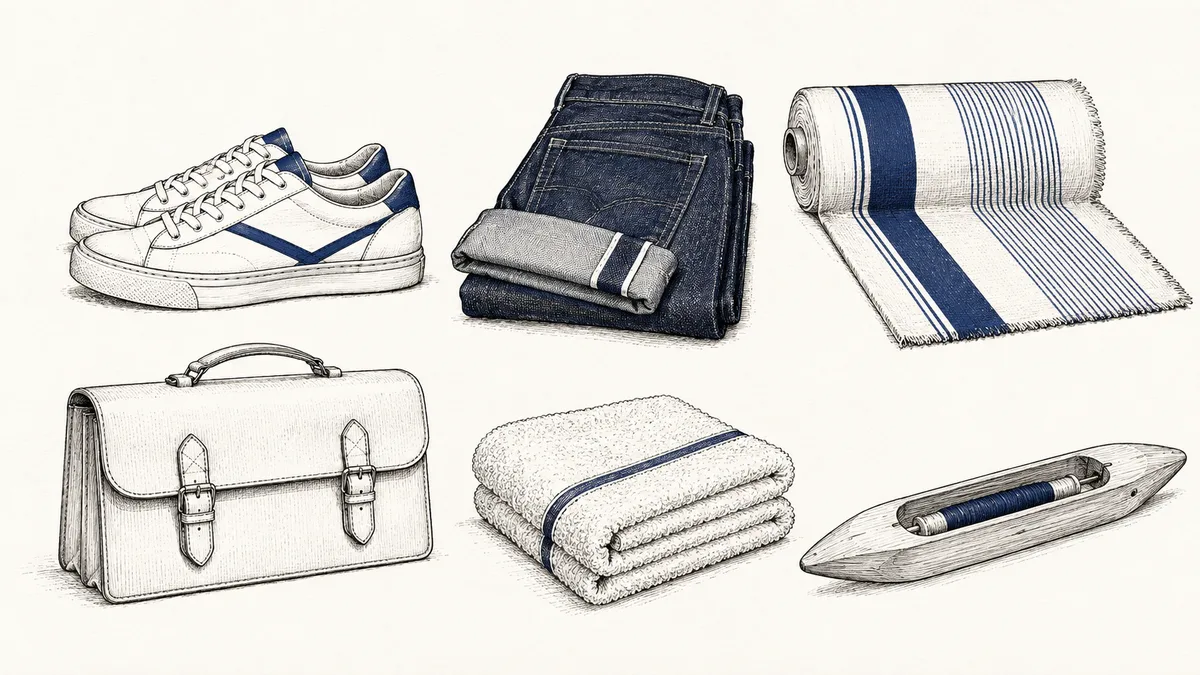
This is a map of that country, drawn for people who are not in it. Everything below comes from pages the companies publish about themselves, opened on 5 September 2026. When a company describes itself, we say so, because a brand's own words are evidence of what it wants to be, not proof that it is. When we could not open a source, we say that too, at the end.
Advertising disclosure. Some brand names below link to a search results page on Rakuten Ichiba, a Japanese online marketplace, through an affiliate link. If you buy something after following one, this site earns a commission. Three things worth knowing before you click: the destination is a search result, not an official store and not a recommendation of any particular item; the sellers are independent shops, so condition, authenticity and price vary; and Rakuten Ichiba's checkout is in Japanese, with international shipping decided by each seller. Links marked PR are affiliate links. Nothing in this article was chosen because of them.
Two ways of being large
Japan has two kinds of giant, and they run on different machinery.
The first kind makes clothes. UNIQLO calls what it sells LifeWear, and defines the word on its own site: LifeWear is clothing designed to make everyone's life better. It is simple, high-quality, everyday clothing with a practical sense of beauty—ingenious in detail, thought through with life's needs in mind, and always evolving.
That is a business model written as a promise. It explains why a UNIQLO store feels like a stationery shop for the body, and why the interesting question about the company each season is what got re-engineered: a fabric, a seam, a pocket. GU, its sibling label, has its own site and its own channel on this site. We did not open a corporate page for GU, so we say nothing about it here.
The second kind sells other people's clothes. ZOZOTOWN belongs to ZOZO, Inc., established in May 1998 under the name Start Today. Its history page says the business started out by selling imported CDs and records, based on mail orders from a catalog
. The store itself launched in December 2004 as a fashion e-commerce site, Introducing items from 17 apparel select stores
. Seventeen. The same page records what grew from there: the styling app WEAR, the secondhand shop ZOZOUSED, a multi-size service, and a fulfilment business for brands. It also records the failures, which is rarer and more useful. ZOZO introduced ZOZOSUIT, a 3D body-measurement suit, and then wound it down: Distribution ended in Oct. 2019 / Service closed in Jun. 2022
. It launched a global version of the store, ZOZOTOWN.COM, and closed it: Service closed in Jul. 2014
. A Chinese site and a Taobao shop closed in January 2013. A Korean storefront inside eBay's G Market closed that June.
Put those closures side by side and you have the one fact to carry out of this section: ZOZOTOWN is a domestic machine. It was built for shoppers in Japan, it tried the world outside Japan three times, in China, in Korea and with a global site, and it closed all three. Hence the habit, in the sections below, of noting which makers ship abroad themselves. For several of them that is the only door.
If you are about to use a Japanese store for the first time, our older guide on returns, size charts and care labels is in Japanese, but its headings survive a translator, and its first rule is the one that counts: read the shop's own written return terms before you order, because those terms are what you will be held to.
The buildings people mean when they say Harajuku
Some of the names in Japanese fashion are addresses. Laforet Harajuku, run by Mori Building, opened in 1978 in what its operator calls 明治神宮の街・原宿
, Harajuku, the town of the Meiji Shrine, with, in its own words, a theme of 街づくり
, city-making, and a view of fashion as 時代を表現するカルチャー全般
: culture as a whole, expressing its era. Nearly fifty years on, that sentence still describes what the building does better than any floor plan could. A label's first shop inside Laforet, or inside Shibuya PARCO, or inside SHIBUYA109, is a statement about which audience it thinks it has.
This site lists all three as social accounts: each posts on X, PARCO on Instagram as well, and we could not verify a YouTube channel for any of them.
The shoe with an asterisk
Ask why a visitor would stand in line outside a Tokyo shop for a sneaker sold worldwide and you will not find the answer in a press release. We found no primary source that documents the queues, so we do not assert them. The part we can document is why the Tokyo shelf is different, and the company wrote it down itself.
The story starts a long way from fashion. In 1949, after returning from the war, Kihachiro Onitsuka founded ONITSUKA Shokai in Kobe; the same year it became ONITSUKA Co., Ltd., with two employees and a capitalization of 300,000 yen
. Its first sports shoe, in 1950, was a basketball shoe, chosen, the company says, because basketball shoes were then thought the hardest to make. In 1966, after an in-house design competition, the firm introduced the Mexico line (the current ASICS stripes)
. Note that this is the stripe design, not a shoe of that name. In 1977 three companies merged as equals to become ASICS Corporation, its name the initials of Anima Sana In Corpore Sano
, a sound mind in a sound body.
The brand you can buy today is a revival. In 2002 ASICS re-issued the ONITSUKA TIGER name: Models such as the MEXICO66, ULTIMATE81, and NIPPON60 are re-released under the ONITSUKA TIGER brand.
In 2003 the first directly-managed store opened in Tokyo, and After that, stores open one after another in Paris, London, Berlin, Amsterdam, and other cities.
In 2012, for the tenth anniversary of the revival, the Omotesando flagship opened in Shibuya, Tokyo. The company's history page describes it as, by floor area, the largest of all directly-managed ONITSUKA TIGER stores in the world
. That is the page's description as of 2012; we have not checked whether it still holds.
Two later entries answer the question. In 2008 the brand launched NIPPON MADE, two models of which Every part of the shoe down to the tiniest detail is made in Japan.
In 2017 it announced ONITSUKA TIGER Omotesando NIPPON MADE, the world's first NIPPON MADE series retail store
. The brand describes the line as made to showcase the marvels of Japanese craftsmanship to the world
, produced in domestic factory
, and finished using traditional Japanese washing and dyeing techniques
, so that No two pairs of these shoes, products of Japan's superb craftsmanship, are alike.
At the bottom of that page sits one asterisk, and it is the whole answer: *Some items are Japan exclusive.
Hold two pairs of the same NIPPON MADE model side by side and, if the page is right, the washing and dyeing will have left them different from each other. Some of what sits next to them on a Japanese shelf is sold nowhere else. That is the trip: a shelf that exists at one end of the supply chain only. Onitsuka Tiger on Rakuten IchibaPR
A town that makes trousers
Kojima, in Okayama Prefecture, is where two of the three denim makers here come from, and one of them, Momotaro JeansPR, opens its own story with the town: Kojima, a town of Okayama Prefecture, is a world-renowned denim production area. MOMOTARO JEANS was born in this town.
Its signature is a colour, 特濃-TOKUNO BLUE
, a deep indigo the brand says it reaches by dyeing many times
. Its English store ships internationally, and on its US-facing pages it advertises free shipping above a set order value together with No Import Duties
, plus free size advice and exchanges. The banner is written per region; opened from elsewhere, the same page quotes a different currency and threshold. Read the terms for your own country on the day you order.
Down the same roads, Kojima GenesPR lists items like 14oz Selvedge Straight Denim
, 18oz Straight Denim
, a hickory no-collar shirt and a denim work shirt, a catalogue that reads like a parts list for workwear.
The third maker is from Osaka, and it is the one that claims to have taken Japanese denim to the world. EVISUPR was founded in Osaka Japan in 1991 and is named after the Japanese God of prosperity Ebisu
. Its account of the first years deserves quoting whole: Initially only around 14 pairs of jeans a day were created, each one caringly hand-painted with the now famous seagull logo.
The company says this spurred a revial of interest in vintage denim which spread around the world
. The typo is theirs, and so is the claim.
Shoes, bags and towels
The next three makers are factories with a name on the door, which is a different thing from a fashion label and, for a visitor, a harder thing to find.
SPINGLEPR describes itself in the title of its English site as Japanese Shoes, Handcrafted in Hiroshima
. Its company page gives an establishment date of April 1997 and an address in Fuchu, Hiroshima Prefecture.
Tsuchiya KabanPR, Tsuchiya Bag Manufacturing, began in 1965 in what its own history calls 東京の下町の小さな工房
, a small workshop in Tokyo's old downtown, making randoseru, the boxy satchel a Japanese child carries through the six years of primary school. The company describes that first work as bags supporting 子どもたちの6年間の成長
, six years of children's growth, and says it began making adult products 35年後
, thirty-five years later, in 2000. In 2022, the same page says, the founder, Kunio Tsuchiya, was named one of Japan's 現代の名工
, the Contemporary Master Craftsmen chosen by the Ministry of Health, Labour and Welfare, as the leading maker of leather randoseru; the page adds that he is past eighty and still stands in the workshop, and that 600名
, six hundred craftspeople and staff, carry on his approach. A bag maker whose first design brief was six years of daily use by a child now offers what it calls 永久サポート
, permanent support: repairs, it says, 製品が役目を終える日まで
, until the day the product's work is done, however many years ago you bought it. Its English site also teaches you to say the name: Tsoo-chie-yah Kah-Bahn
.
IKEUCHI ORGANICPR weaves towels in Imabari, Ehime, a city it describes as 日本一のタオル産地
, Japan's foremost towel-producing region. Founded in 1953 as Ikeuchi Towel, it took its present name on its sixtieth anniversary, in 2014. The surprise is in the early history: it began as an exporter, making bath towels for Europe and America 日本でまだバスタオルが普及していなかった時代
, at a time when the bath towel had not yet caught on in Japan. Its first customers were in the Middle East; later ones were in Europe, Germany above all. If you want the region rather than one company, Imabari towelsPR are sold under a shared regional brand.
Names older than the fashion industry
Kimono textiles are the part of Japanese clothing run by family businesses with centuries on the clock, and the part where the vocabulary gets hard. Three words will get you through: a house, a weave, and a cloth.
The house. ChisoPR was founded in 1555 in Kyoto, at Karasuma Sanjo, as a dealer in Buddhist and ceremonial vestments, trading under the shop name Chigiriya. By the Edo period it was supplying vestments to Higashi Hongan-ji and to noble and imperial households. In the title of its own site it still calls itself 京友禅着物の老舗
, a long-established house of Kyoto yuzen kimono.
The weave. Hakata-oriPR, from Fukuoka, is described by its weavers the way an engineer would describe it: pre-dyed yarns, many fine warp threads, a thick weft beaten in hard with the reed, the pattern raised mainly by floating the warp. The cloth comes out with body and tension and, in their phrase, 締めたら緩まない
, once tightened it does not slacken. That made it the belt for a samurai carrying a heavy sword, and, the weavers add, 今でもその特性が活かされています
, the same property is still put to use today. The signature pattern is called kenjo, "presented", because from 1600, when Kuroda Nagamasa took the province, ten lengths of obi cloth and three bolts of raw silk went to the shogunate every March.
The weavers date the craft's arrival to the year, and state it flatly: Mitsuda Yazaemon left Hakata for Song China in 1235 with the monk Enni Ben'en, stayed six years, learned five techniques, weaving among them, and returned in 1241. That is the industry's own account of its origin, written on its own site without hedging. We have not tried to verify a thirteenth-century voyage.
The cloth. Tsumugi is the one to understand, because it inverts what silk is supposed to be. Tsumugi thread is spun from the cocoons that were not good enough to reel into filament silk. The Kyoto wholesaler Hirota Tsumugi explains it this way: those waste cocoons are opened into floss and spun by hand, dyed with plant dyes, and woven; because the yarn carries irregular slubs the cloth is very tough, so it was worn as 野良着
, farm clothes. Filament silk glitters. Tsumugi has a dull, low shine, the cloth that did not announce money, and for that reason it became the connoisseur's everyday kimono: 渋い色合い、素朴な柄で贅を主張することのない紬は、粋な普段着として人気を博す
. One of the named regional kinds is Honba Oshima TsumugiPR, which has its own producers' cooperative. The makers are candid about the present. Work in the old methods takes enormous labour and skilled hands, and 各産地では後継者不足からその伝統を伝えていくことがますます困難になっています
: across the producing regions, a shortage of successors is making the tradition harder and harder to pass on. That is their sentence, not ours.
The designers you meet on the second visit
Rei Kawakubo, Yohji Yamamoto and Issey Miyake are covered in our piece on the designers who changed fashion history, in Japanese. These three sit a layer below them.
White Mountaineering started in 2006 around one sentence, which the label prints in both languages: The field in which we wear clothes is all outdoors.
Under it, three words, One, design. Two, utility. Three, technology.
, and a line of attitude: The attitude of not submitting to sales or market needs.
One of its lines, BLK, is described as Under the concept “BLACK LAYER KNOWLEDGE”, BLK consists of the garments in black.
beautiful people, designed by Hidenori Kumakiri, was founded in 2006 and, by its own account, made its Paris debut in autumn/winter 2017. Its history page starts with 子供と大人が共有できる服「kidsシリーズ」発表
, clothes that children and adults can share, and later describes a foldable trench coat designed around 和服のたたみ線や直線的なライン
, the fold lines and straight lines of Japanese dress.
visvim explains itself through craftsmen rather than garments. It has, it says, continued our efforts to connect the market with the work of craftsmen who conduct their output with dignity, while protecting the culture and technique that has been passed down from old times.
Its web store carries six sibling brands, visvim, WMV, Indigo Camping Trailer, little cloud coffee, CONTRARY DEPT and Subsequence, and is, in the store's own words, Also available to overseas customers.
What we could not check
Five things we looked for and did not find:
- The queue. We found no primary source documenting people lining up at any shop named here, so we assert no queue anywhere above.
- MEXICO 66. The ASICS history page dates 1966 to the introduction of the stripe design, and the shoe appears on that page only as re-released in 2002. We have not found the shoe's original release year in a primary source, so we have not given one.
- BEAMS and SHIPS. Two of Japan's best-known select shops. We could not open beams.co.jp at all (connection failure, three attempts), and shipsltd.co.jp returned 403. We did not want to write about them from memory, so we have not written about them at all. They are in this site's channel list; their own sites are the place to read about them.
- Store counts, revenue and rankings for any company here. We did not open financial filings, so there are no numbers of that kind above.
- Whether the Omotesando flagship is still the largest. The company's page says so of 2012. We have not verified today.
Where to start looking
Most of the makers above publish video, and this site puts those channels next to a player so you can watch before you buy anything: Onitsuka Tiger, Momotaro Jeans, Kojima Genes, EVISU, SPINGLE, Tsuchiya Kaban, IKEUCHI ORGANIC, Chiso, Sanui Orimono, Hirota Tsumugi, Honba Oshima Tsumugi, beautiful people, UNIQLO and ZOZO. Several of them post in Japanese only. Open them anyway.
Open Sanui Orimono's last. It is small, and as of September 2026 its feed lists fourteen videos, the newest from February 2025: a lesson in folding a pocket square, an official music video called サ・サ・サヌイの博多織!
, and a coin-purse series done with the manga Fist of the North Star. The same company states on its website, without hedging, that its craft came home from China in 1241. The distance between those two facts is the country this article set out to draw.
Sources
Every quotation above was read on the companies' own pages, or in one case a company's own YouTube feed, on 5 September 2026. In the order they appear: UNIQLO, About LifeWear; ZOZO, Inc., Company History and Service; Rakuten Fashion; Laforet Harajuku, business outline; ASICS, ASICS History and Onitsuka Tiger, NIPPON MADE; Momotaro Jeans, About and Shipping; Kojima Genes; EVISU, About us; SPINGLE, company outline; Tsuchiya Kaban, about and its English about page; IKEUCHI ORGANIC, brand story; Imabari Towel; Chiso, history; Sanui Orimono, about Hakata-ori and its YouTube channel feed; Hirota Tsumugi; Honba Oshima-Tsumugi Orimono Cooperative Society; White Mountaineering, About; beautiful people, History; visvim, About visvim. None of these links are affiliate links.
Prices, stock and international shipping conditions change. Check each brand's or shop's own site before you buy. Sources for every dated fact above are the companies' own pages and feeds, opened on 5 September 2026.